
Stock markets closed higher for the second straight session on Tuesday, driven by gains in bank, IT and capital goods shares.

Though some ingredients such as mild odours or silicones might not be actually harmful, others such as sulphates, parabens or formaldehyde releasers can result in skin irritation, hormonal imbalances and skin barrier damage, advises Dr Ameesha Mahajan.

New Zealand has liberalised mobility provisions under the concluded trade pact, enabling Indian students to access longer post-study work visas and allowing 5,000 Indian professionals, including yoga instructors and chefs, to work in the Oceania country.

Discover the latest OTT releases, streaming between February 23 and March 1.

Hyderabad is rapidly emerging as a strategic hub for multinational companies (MNCs) deepening their focus on artificial intelligence (AI), life sciences, and global capability centres (GCCs), supported by the city's strong pharmaceutical (pharma) base, deeptech talent pool, and a policy environment that encourages high-value investment.

Stock market benchmark indices Sensex and Nifty ended 2.5 per cent higher on Tuesday after India and the US agreed to a trade deal under which Washington will bring down the reciprocal tariff on Indian goods to 18 per cent.

The US Food and Drug Administration (USFDA) recorded a significant decline in serious regulatory findings at Indian drug manufacturing facilities between January and December 2025. Data reveals that 'official action indicated' (OAI) cases - the most severe classification - nearly halved over the past year.

In November, six primary market issuances accounted for more than 13,000 crore of net equity investments by MFs.

Gold imports climbed 349.22 per cent to $12.07 billion in January, while silver imports rose 127 per cent to $2 billion.

'The bigger unknown remains global geopolitics, which is inherently unpredictable, including developments in our neighbourhood.' 'Another concern is the increasing tilt of government finances towards welfare subsidies, especially at the state level.' 'This could constrain capital expenditure, which is critical for long-term growth.'

The government on Sunday gave a strong push to upgradation and expansion of healthcare infrastructure, medical education and pharma sector with the Union Budget 2026-27 announcing a slew of steps, including those aimed at making India a global hub for allied healthcare professionals and biopharma manufacturing.

Trade deals ease risks for Indian equities, but weak demand and stretched valuations raise questions over whether optimism -- especially in smallcaps -- can turn into a sustained bull run, points out Debashis Basu.
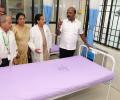
Tamil Nadu has formed special teams to monitor drug manufacturers after deaths of infants in Madhya Pradesh were linked to a cough syrup made by a Tamil Nadu-based company. Inspections are being conducted at pharmaceutical firms across the state.

Open offers this calendar year, following attempts at acquisition and takeover, came in at more than two a week. There were 121 such open offers to acquire additional shares following a substantial acquisition or change of control, shows the data compiled by primedatabase.com.

A top executive of Sigachi Industries has been arrested in connection with the explosion at its pharma plant in Telangana in June, which resulted in 54 deaths.

'We have tags of state animals and birds. However, the invisible world of microbes is doing a lot of things for us in nature, not just for human beings but for the entire life.'

There were 18 exits from the index between 1995 and 2000. The pace has since dropped to single-digit exits over every five-year period.

For patients, the immediate impact is a reduction in the final cost of therapies that often run into lakhs per month.
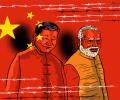
India's trade deficit with China is expected to reach $106 billion in 2025 as imports are rising faster than the country's exports to the neighbouring country, think tank GTRI said on Friday.

The International Excellence Scholarship (Postgraduate) 2026 aims to help students from financially challenged backgrounds with their college education.

The Enforcement Directorate (ED) raided premises linked to Sresan Pharmaceuticals, the manufacturer of Coldrif cough syrup linked to the deaths of children in Madhya Pradesh and Rajasthan, and top officials of the Tamil Nadu FDA as part of a money laundering investigation.

Which were India's first companies that still exist today? Many trace their origins to over a century back. These venerable organisations are business entities. But they chronicle the beginnings of Corporate India.

The Bengaluru police have launched a probe into a cyber fraud case where hackers allegedly infiltrated the official email communication between city-based Group Pharmaceuticals and Dr Reddy's Laboratories, Hyderabad, successfully diverting a payment of Rs 2.16 crore to a fraudulent account.
Indian Pharmaceutical Alliance (IPA) on Friday said US President Donald Trump's move to impose 100 per cent import tariffs on pharmaceutical drugs from October 1 will impact only patented and branded products, not generic medicines.
Buoyant domestic sales are expected to lift revenues for pharma companies by 8-11 per cent in Q3FY26, even as declining generic Revlimid (cancer drug) sales in the US remain a key drag. Most brokerages forecast a modest 2-4 per cent growth in profit after tax (PAT) for the quarter. Hospitals and diagnostics companies, meanwhile, are likely to post much stronger numbers, with revenues seen growing 20-22 per cent year-on-year (Y-o-Y).

Trump said that the decision would be "immediately" in effect and that the "order is final and conclusive."
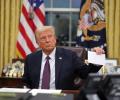
President Trump announces 100% tariffs on movies made outside the US, potentially impacting the Indian film industry. The move follows similar tariffs on pharmaceutical products.

Pharma major Dr Reddy's Laboratories (DRL) reported a 14 per cent year-on-year (Y-o-Y) drop in consolidated net profit to Rs 1,210 crore in the December quarter of FY 2025-26 (Q3FY26) on low sales of cancer drug Lenalidomide in the North American market. The firm's revenue from operations grew to Rs 8,727 crore in Q3FY26, a 4.4 per cent Y-o-Y increase from Rs 8,357 crore recorded for the same quarter last year.

In the wake of the FTA between India and the European Union, the United States has described the Europeans as 'very disappointing', saying they were unwilling to join Washington, DC in putting tariffs on New Delhi for its purchases of Russian oil because of this trade deal.

New Zealand Prime Minister Christopher Luxon on Monday said the negotiations for a free trade agreement with India have been concluded.

The Congress MP said he had been "troubled" by the US tariff regime from the very beginning, adding that India was already at a disadvantage compared to its regional competitors.

India and the European Union (EU) on Tuesday announced the conclusion and finalisation of negotiations for the proposed free trade agreement (FTA).

Uttar Pradesh authorities have registered 74 cases and arrested 75 people in connection with the illegal storage and sale of codeine-based cough syrup. A minister alleges links to the Samajwadi Party and an SIT is investigating.

FDI inflows into India are expected to register robust growth in 2026, supported by strong macroeconomic fundamentals, big-ticket investment announcements, sustained efforts to improve the ease of doing business, and a new generation of investment-linked trade pacts.

Most pharma shares dropped, dragging the BSE Healthcare index down by 2.14 per cent after Trump's move to impose 100 per cent import tariffs on pharmaceutical drugs from October 1. Wockhardt shares tanked 9.4 per cent.

'When markets go into a budget with excessive optimism, the risk of disappointment is higher.'

The fiscal tilt towards capex benefits companies in investment-related sectors like capital goods, defence equipment, engineering & construction and metal & mining. The planned cut in revenue expenditure will weigh on companies in consumption sectors like FMCG, consumer durables and retail.

Among the Sensex firms, State Bank of India, Maruti Suzuki India, Axis Bank, NTPC, BEL, Adani Ports, Eternal, Sun Pharmaceuticals, Power Grid, ITC, UltraTech Cement, Trent, HCL Technologies, Mahindra & Mahindra, and HDFC Bank were the major gainers. On the other hand, Tata Steel, Tata Consultancy Services, Tech Mahindra, Titan, Bajaj Finserv, Tata Motors, Bharti Airtel and Bajaj Finance were among the laggards.

Following deaths allegedly linked to contaminated cough syrup, Pune FDA initiates action against pharmacies selling without prescriptions and prohibits stock from a Gujarat-based firm.
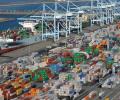
'The immediate impact for India will be very minimal as the share of Venezuela in our total overseas production is very low.'
